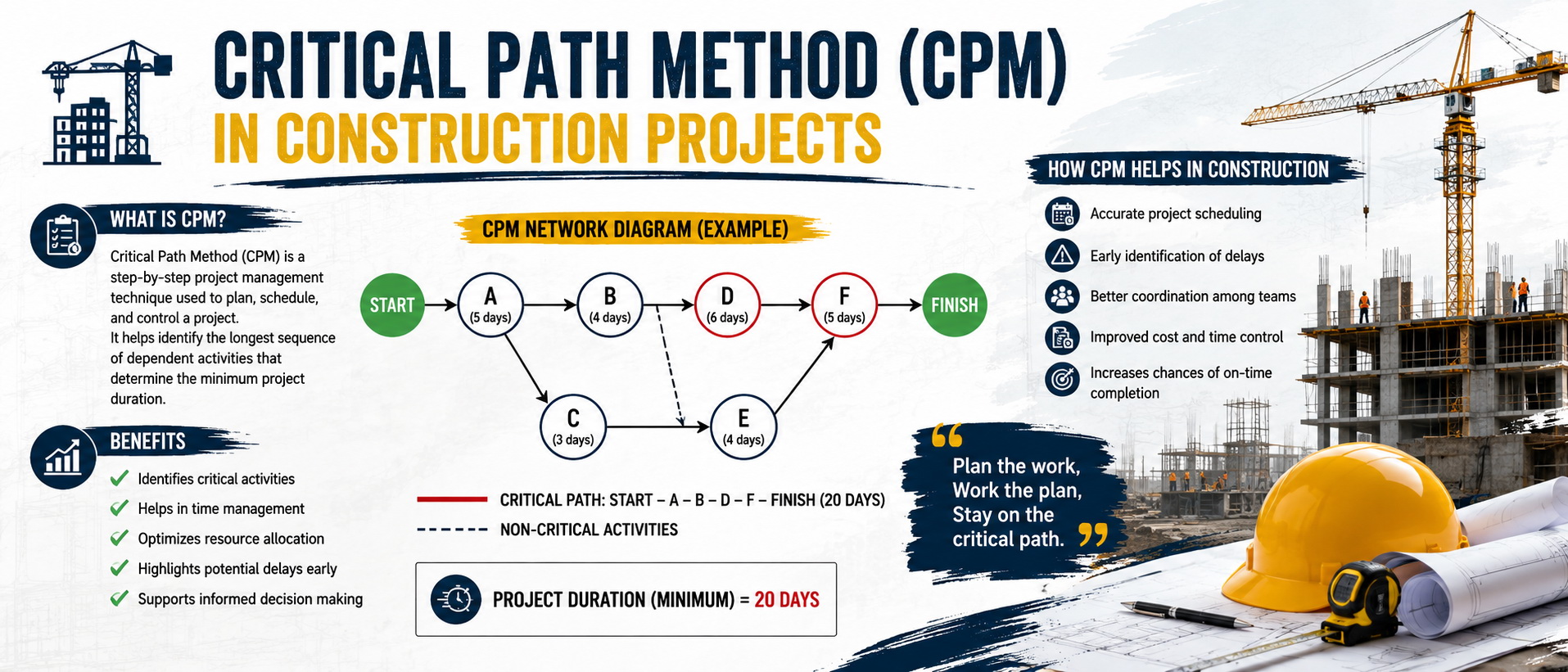
Critical Path Method (CPM) in Construction Projects: A Complete Guide
Introduction
Successful construction projects depend on effective planning and scheduling. Regardless of project size, construction managers must understand which activities directly influence project completion and which activities have scheduling flexibility. One of the most widely used scheduling techniques in construction is the Critical Path Method (CPM). The Critical Path Method helps project teams identify critical activities, predict project completion dates, monitor delays, allocate resources efficiently, and improve project control. Today, CPM forms the foundation of modern construction scheduling software such as Primavera P6 and Microsoft Project and remains one of the most important tools in construction planning and project controls. This guide explains the Critical Path Method, how it works, its benefits, common challenges, and best practices for construction projects.
What Is the Critical Path Method (CPM)?
The Critical Path Method (CPM) is a project scheduling technique used to identify the sequence of activities that determines the shortest possible project completion duration. The critical path represents the longest chain of dependent activities within a project schedule. Any delay to an activity on the critical path will directly delay the project's completion date unless corrective action is taken.
In simple terms:
Critical Activities = Activities That Cannot Be Delayed Without Affecting Project Completion
Understanding the critical path allows project managers to focus attention on activities that have the greatest impact on project success.
Why Is CPM Important in Construction?
Construction projects involve hundreds or even thousands of interconnected activities. Examples include:
- Site Preparation
- Foundations
- Structural Works
- Mechanical Installation
- Electrical Installation
- Architectural Finishes
- Testing & Commissioning
Not all activities have the same impact on project completion. The Critical Path Method helps project teams identify:
- Critical Activities
- Project Duration
- Schedule Risks
- Float Availability
- Delay Impacts
This information supports better decision-making throughout the project lifecycle.
Key Components of the Critical Path Method
Activities
Activities are individual tasks required to complete the project. Examples include:
- Excavation
- Reinforcement Installation
- Concrete Pouring
- Masonry Work
- HVAC Installation
Each activity has a defined duration.
Dependencies
Activities are connected through logical relationships. Common dependency types include:
- Finish-to-Start (FS)
- Start-to-Start (SS)
- Finish-to-Finish (FF)
- Start-to-Finish (SF)
Dependencies determine the sequence of work.
Duration
Each activity has an estimated duration. For example:
- Excavation = 5 Days
- Foundation Concrete = 7 Days
- Structural Framing = 20 Days
Accurate durations are essential for reliable schedules.
Float
Float represents the amount of time an activity can be delayed without affecting project completion. There are two primary types:
· Total Float: Time available before project completion is affected.
· Free Float: Time available before successor activities are affected.
Activities with zero float are generally critical activities.
What Is the Critical Path?
The critical path is the longest sequence of dependent activities that determines the project completion date. Characteristics of critical path activities include:
- Zero or Near-Zero Float
- Direct Impact on Completion Date
- Higher Management Attention
- Increased Monitoring Requirements
Any delay to a critical activity may delay the entire project.
Example of a Simple Critical Path
Consider the following simplified project:
· Activity A → Site Preparation → 5 Days
· Activity B → Foundations → 10 Days
· Activity C → Structure → 20 Days
· Activity D → Finishes → 15 Days
· Activity E → Commissioning → 5 Days
These activities form a continuous sequence.
Total Project Duration:
5 + 10 + 20 + 15 + 5 = 55 Days
This sequence becomes the project's critical path.
If any activity is delayed, the project completion date will also be delayed.
How CPM Works
The Critical Path Method involves several steps.
Step 1: Define Activities - Identify all project tasks required for completion.
Step 2: Establish Logic Relationships - Determine the sequence in which activities must occur.
Step 3: Estimate Durations - Assign realistic durations to each activity.
Step 4: Create Network Logic - Develop the project schedule network.
Step 5: Calculate Early and Late Dates - Determine:
- Early Start
- Early Finish
- Late Start
- Late Finish
Step 6: Identify Float - Calculate available scheduling flexibility.
Step 7: Determine the Critical Path - Identify activities with zero float that control project completion.
Benefits of CPM in Construction Projects
· Improved Schedule Visibility: Project teams gain a clear understanding of project priorities.
· Better Resource Allocation: Resources can be directed toward critical activities.
· Early Delay Identification: Potential schedule risks become visible before they impact project completion.
· Improved Decision-Making: Management can focus on activities affecting project outcomes.
· Enhanced Project Control: CPM supports proactive project management rather than reactive problem-solving.
CPM and Primavera P6
Primavera P6 uses the Critical Path Method as the foundation of schedule calculations. The software automatically calculates:
- Critical Activities
- Float Values
- Project Completion Dates
- Schedule Impacts
This enables planners to manage large and complex construction schedules efficiently.
CPM and Delay Analysis
Critical Path Analysis plays a vital role in construction claims and Extension of Time (EOT) requests. Delay analysis evaluates:
- Which activities were affected
- Whether delays impacted the critical path
- How delays influenced project completion
Without CPM, it becomes difficult to justify schedule-related claims.
Common CPM Mistakes
Many project schedules fail to provide meaningful results due to poor development practices. Common mistakes include:
· Missing Logic Relationships: Activities not properly linked.
· Excessive Constraints: Artificial constraints hiding true project logic.
· Unrealistic Durations: Activity durations that do not reflect actual conditions.
· Lack of Schedule Updates: Outdated schedules lose management value.
· Incorrect Critical Path Identification: Improper schedule development may produce misleading results.
How to Maintain an Accurate Critical Path
Project teams should:
- Update schedules regularly
- Verify logic relationships
- Monitor progress frequently
- Review float values
- Analyze schedule changes
- Conduct periodic schedule audits
These practices improve schedule reliability.
CPM and Project Controls
Project Controls teams rely heavily on CPM for:
- Progress Monitoring
- Forecasting
- Delay Analysis
- Resource Planning
- Performance Reporting
Critical Path Analysis provides the foundation for effective project controls.
Warning Signs That Your Critical Path Needs Review
Projects may require schedule review when:
- Critical path changes frequently
- Float values appear unrealistic
- Activities are missing logic
- Milestones are slipping
- Progress updates are inconsistent
Regular reviews help maintain schedule accuracy.
Best Practices for Critical Path Management
To maximize CPM effectiveness:
· Develop Detailed Schedules: Avoid oversimplified activity structures.
· Use Professional Scheduling Software: Primavera P6 remains the industry standard.
· Update Progress Regularly: Maintain accurate project status information.
· Monitor Critical Activities Closely: Focus management attention where it matters most.
· Conduct Delay Analysis: Identify schedule risks before they escalate.
The Role of CPM in Modern Construction Management
Modern construction management depends on reliable scheduling information. Critical Path Method supports:
- Project Planning
- Schedule Management
- Resource Allocation
- Delay Prevention
- Risk Management
- Claims Preparation
Projects without effective critical path management often experience reduced visibility and increased schedule risks.
Conclusion
The Critical Path Method remains one of the most important tools in construction planning and project controls. By identifying the activities that directly influence project completion, CPM enables project teams to focus resources, monitor progress, manage risks, and improve project performance. Whether using Primavera P6, Microsoft Project, or other scheduling platforms, understanding and managing the critical path is essential for successful project delivery. Organizations that effectively implement CPM gain greater schedule visibility, stronger project controls, and improved confidence in achieving project objectives.
Leave a Comment